
Another entry in my travel series.
Some places are easy to leave. You stop the car, take some photos, go for a walk to loosen up, and within fifteen minutes, you’re back on the road again, the place already fading into the rearview mirror of the trip while you think, “That was nice; I’m glad I was there.”
Other places are different. They slow you down in a way that’s hard to explain. You arrive expecting to look around for a few minutes, and before you know it, you’ve been standing there for half an hour just quietly taking it in.
That was my experience at Zabriskie Point.
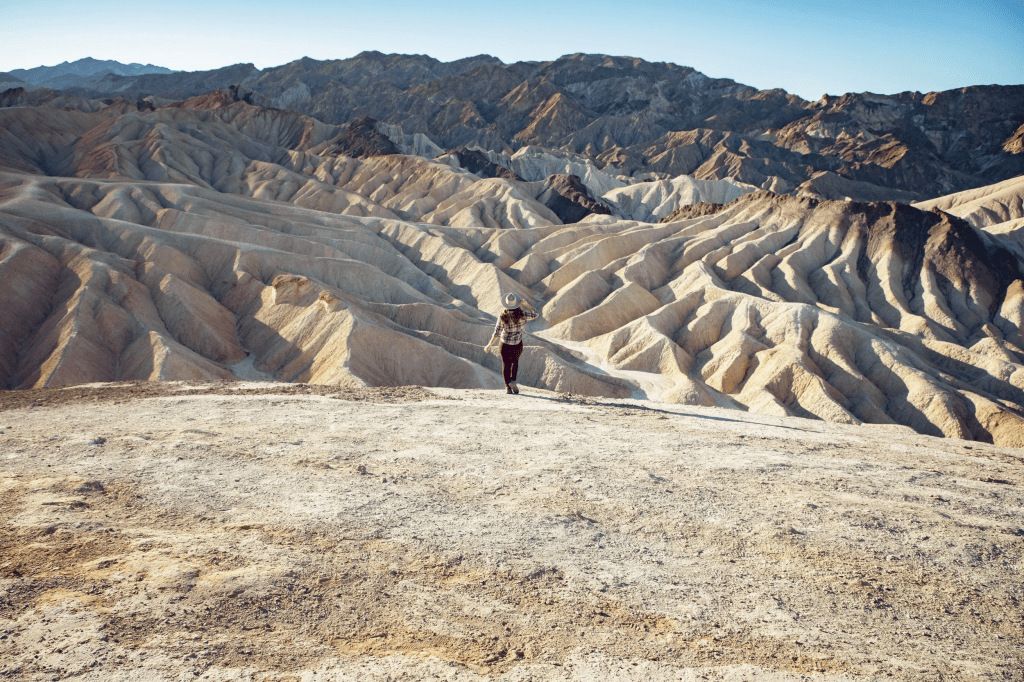
There are plenty of stunning places nearby in Death Valley National Park – sand dunes, salt flats, and desert mountains that seem to stretch endlessly. But Zabriskie Point has a kind of strange, sculpted beauty that almost looks unreal at first glance.
The landscape is a series of soft, folded hills and ridges carved by erosion over thousands of years. The colors shift depending on the angle of the sun – gold, beige, rust, sometimes almost glowing in the late afternoon light. It doesn’t look like the kind of terrain most people imagine when they think of the desert. It looks more like a painting and I’ve heard it described as such.
The interesting thing is that my original inspiration for going there had nothing to do with geology. It came from music. Years earlier, I had read that “You Got the Silver” by The Rolling Stones was used in the 1970 film Zabriskie Point, and that little bit of trivia had stayed somewhere in the back of my mind.
When I eventually found myself traveling through that part of the country, the name jumped out at me on the map. So I went. And like many of those places in the American Southwest, it turned out to be one of those stops where you linger longer than expected.
There are certain landmarks that create the same kind of reaction.
You arrive at Meteor Crater in Arizona and spend several minutes simply staring at the enormous hole in the earth from different vantage points, trying to grasp the scale of what happened there.
You walk up to the edge of the Grand Canyon, and the first thing that hits you is how quiet it is. Not literal silence – there are usually plenty of visitors around – but the kind of mental pause that happens when your brain is trying to process something too large to easily absorb. You also notice there is no guardrail for the most part, and if you stand too close to the edge, a sudden, sharp gust of wind will send you tumbling down to the bottom of the canyon with no hope of survival.
Or you stand somewhere in the Rocky Mountains and realize that photographs never quite capture what it feels like to actually stand there.
Places like these raise an oddly simple question. How long are you supposed to look at them?
There’s a scene in National Lampoon’s Vacation where the Griswold family finally reaches the Grand Canyon after hours of driving. They step out of the car, look at the canyon for a moment, and then almost immediately turn around and leave. The scene is played for laughs, but there’s actually a bit of truth hiding in that joke. Because when you arrive at a place that vast or beautiful, there’s a brief moment where your brain seems to ask: Okay… now what?
Do you stare at it for five minutes? Ten? An hour? The answer is probably: Long enough. Standing at Zabriskie Point, I realized that there probably isn’t a correct answer. You look long enough to take it in and absorb it. Long enough for the place to register as more than just another stop on a travel itinerary.
For some people, that might be five minutes, and for others it might be forty-five.
But the places that stay with you are usually the ones where you pause long enough to actually feel where you are. The sense that the landscape has been sitting there for countless years, completely indifferent to how briefly we pass through it.
Looking back on road trips through the Southwest, the places I remember most clearly are the ones where I lingered a little longer than planned. Zabriskie Point was one of them.
Places where the original plan might have been a quick stop, but something about the landscape quietly convinced you to stay a while. Maybe that’s the real measure of a great travel destination.

