
The next entry in my occasional travel series of places I’ve been to.
Visiting Gettysburg National Military Park isn’t like touring a museum. There are no glass cases separating you from the past. You walk on it. You stand where it happened. You feel the scale of it under an open sky that looks far too peaceful for what unfolded there.
The fields are wide now. Almost serene. But in July of 1863, they were chaos.
More than 150,000 soldiers converged on the small town of Gettysburg, Pennsylvania, during the American Civil War. For three days, Union and Confederate forces fought what would become the bloodiest battle ever fought on American soil.
Roughly 51,000 men were killed, wounded, or went missing. That number is easy to read but hard to comprehend.
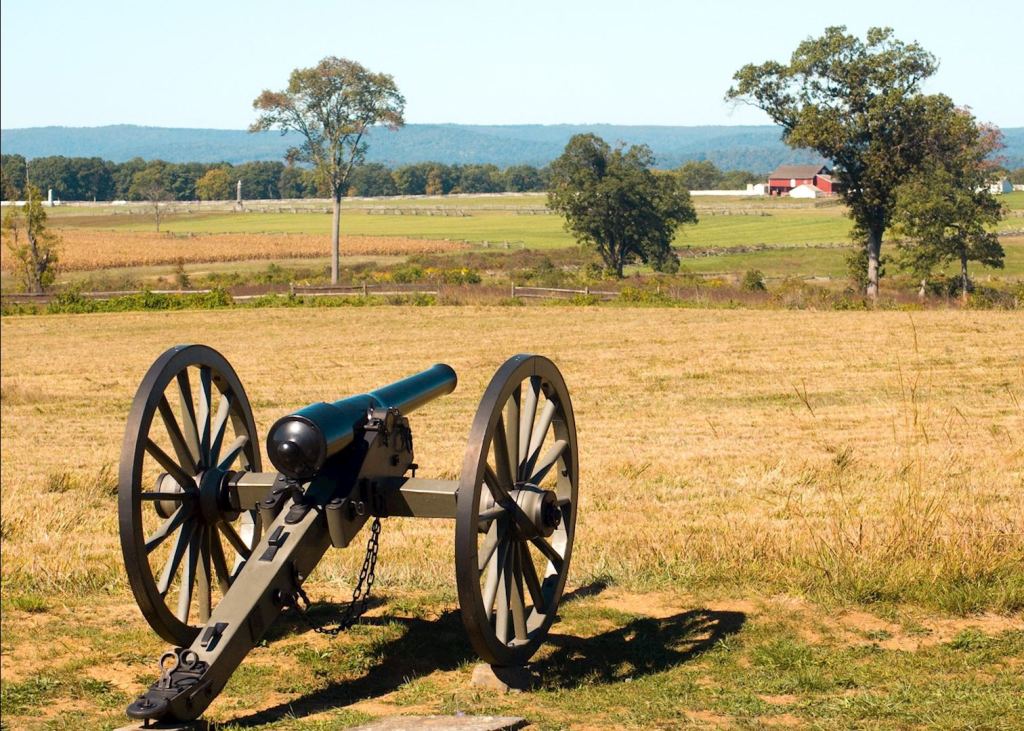
When you walk through the park, you begin to understand why people say the ground feels heavy. You climb Little Round Top and look down across the rolling landscape. You stand at the stone wall on Cemetery Ridge. You walk the long, open stretch of field where Pickett’s Charge unfolded – a mile of exposed ground that thousands of Confederate soldiers crossed under relentless artillery and rifle fire. You wonder how many times you stepped on exactly where someone was shot and killed.
It’s quiet now – almost too quiet. You try to imagine the noise, the thunder of cannon fire, the crack of rifles, the smoke hanging thick in the July heat. Men shouting and dying. Horses panicking. Officers trying to maintain order while lines collapsed around them. But what settles deepest isn’t the strategy. It’s the human cost.
These weren’t anonymous figures in sepia photographs. They were young men. Farmers. Clerks. Teachers. Sons. Brothers. Many were barely older than teenagers. Most had never traveled far from home before the war carried them into Pennsylvania.
And there, on farmland and rocky hills, thousands never returned.
You see the monuments erected by states and regiments trying to honor their dead. You read names carved into stone. You notice how many markers simply say “Unknown.” Whenever I see “Unknown” at any battle site, I shudder inside. They may have been unknown in the record, but they were real people. The scale of loss becomes personal when you realize how many families waited for letters that never came.
There’s a sobering shift that happens when you move from reading about history to physically inhabiting its geography.
At many points during my visit, I stood in an open field, wind moving through the grass, and tried to picture what it would have looked like in 1863. No paved roads. No tour buses. Just churned earth, smoke, blood, and confusion.
The beauty of the landscape feels almost unsettling. Because it reminds you that tragedy doesn’t require dramatic scenery. It can unfold in places that look peaceful both before and after.
Three days of fighting reshaped the war. Historians often describe Gettysburg as the turning point, the moment when momentum shifted. Shortly after the battle, President Abraham Lincoln delivered his now-immortal Gettysburg Address, reframing the conflict as a struggle not just for union, but for the very meaning of equality and democracy.
But standing there, the political implications feel secondary to something more immediate: the cost.
More than 7,000 men died during the battle itself. Thousands more would succumb to wounds later. Entire communities back home were hollowed out. Farms were left without sons and children without fathers.
It’s impossible not to think about the randomness of survival. Two men standing side by side. One lives. One doesn’t. A step left or right determining an entire family’s future.
The trip itself was memorable for many reasons – good food, open roads, and conversations along the way. But Gettysburg was the emotional anchor. It grounded the journey in something deeper. It reminded me that travel isn’t only about scenery or novelty. Sometimes it’s about confrontation – standing in a place that forces you to reckon with sacrifice.
When you leave, the fields remain calm. But the weight doesn’t entirely lift. Once you’ve walked that ground – or any historical ground for that matter – you understand that history isn’t distant. It’s layered into the soil beneath your feet.
 johnberkovich.com